
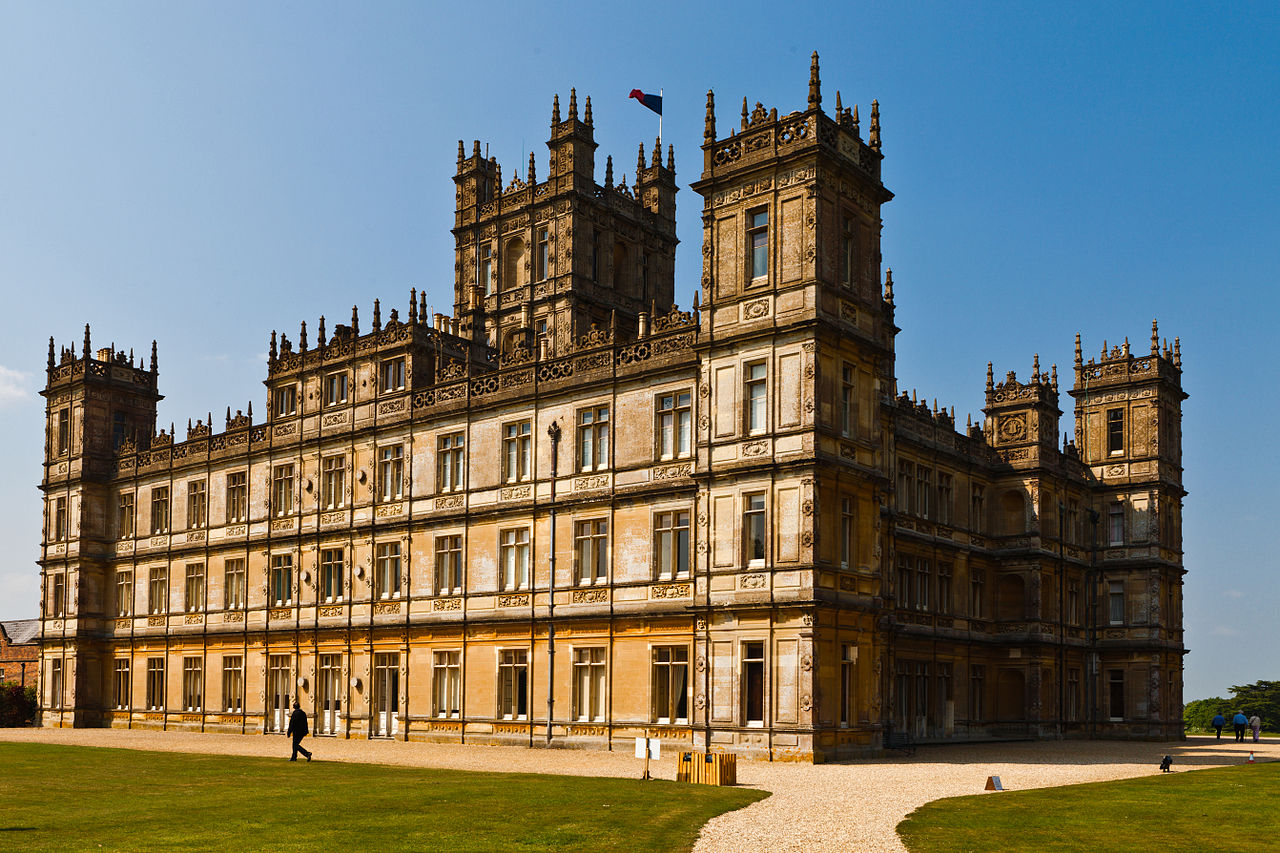
Highclere Castle, filming location for 'Downton Abbey' (Photo: Richard Munckton)
I am apparently the last person in the English-speaking world to watch Downton Abbey, but got a chance to see the first series over the past two evenings. For the unfamiliar, the show takes place in an English country estate around the time of the First World War. Like Mad Men, it is set in a transitional time in a country’s history (in this case, 1910’s Britain), and as such, it is interesting to see how the show deals (or doesn’t) with the dialects of its characters.
Within watching the first few minutes of the program, there is a very obvious dialect divide between the aristocracy (who speak Received Pronunciation), and the servants (who mostly speak with local Yorkshire accents). As with Mad Men, the show’s creators seem to have made striking choices about the speech of the show’s characters, some of which (deliberately) differ from how people actually spoke in the 1910’s.
Most strikingly, the actors who play the wealthy characters eschew older varieties of ‘Upper Crust’ Received Pronunciation for slightly more contemporary varieties of RP. For example, many of the younger actors use some glottal-reinforcement for voiceless plosives like /t/, /p/ and /k/–perfectly normal for modern ‘mainstream’ RP, but probably less so among early-20th-Century aristocrats. Although arguably anachronistic, I think this was a wise move. Because these characters sound more modern, I suspect the choice elicited more natural and unaffected performances from the cast.
(The one brilliant exception to this is Maggie Smith, who plays a Lady Bracknell-ish grandmother with a somewhat more patrician accent; for example, she pronounces ‘off’ as ‘orf’. Smith’s character is of another time, of course, so the fact that her speech is different from that of her progeny is a justifiable choice.)
This is true of the actors who play the servants as well. Most speak with Yorkshire accents (feigned or authentic), but the more inscrutable Yorkshire dialect features are not on display. I admit I’m rather ignorant in this regard: in a country manor a century ago, would the servants have spoken traditional dialects among each other downstairs? Or would standard English have been more typical as a type of lingua franca among staffs that would have no doubt come from a variety of backgrounds?
Perhaps the most fascinating (and ‘meta’) bit of casting in the show is Elizabeth McGovern as the youthful matriarch of the household. McGovern plays an American who married into the British aristocracy and has lived in England for many years; fittingly, McGovern herself moved to England for marriage in the early 90’s and has lived there ever since. This results in the strange situation of an actor with an American accent tinged with British influences (listen to interviews with her on YouTube) adopting an American accent tinged with British influences … from a different time period.
All of this is to say that Downton Abbey is a fascinating show from a linguistic perspective, and I highly recommend it. Any fans wish to comment?
(NOTE: I’m a bit busy in unrelated areas of my life this week, so I may be a bit a light in the comments section.)



The one show that I would LOVE to hear discussions about dialect and accents is Misfits. Check it out on Hulu, if you haven’t already.
Enlightening, thank you!
Cheers,
Claudia
My grandmother was stationed near Harewood House during the war and knocked about with a lass who came from the village which provided its staff. Yorkshire dialect was used by the staff, though the house staff didn’t use it with the Harewoods or their guests. Outdoor staff such as gamekeepers or gardeners didn’t use anything else, and the upper classes usually fully understood the local dialect (my Nanna even told a story about the last Earl of Harewood using it as a joke when talking to a gamekeeper). A generation earlier, highland aristocracy of English origin were often able to speak Gaelic.
@IVV,
I haven’t seen it yet, but (being a fan of British television) will have to check it out!
@Claudia,
Thanks for the support! Glad you enjoyed it.
@boynamedsue,
That’s quite interesting. I’ve always (probably erroneously) bought into the impression that aristocracies, no matter the country, didn’t speak the language of the commoners.
Semi-OT, but one thing I really like about Downtown Abbey is that it portrays the relationship as a much more collaborative one. Whether accurate or not, it shows how our modern era of social mobility has more tradeoffs than one might expect. The attitudes of these century-old characters may be hopelessly classist, but there was also a loyalty to employees and employers that is perhaps missing in the contemporary society. Perhaps; it is a work of fiction, after all.
I have not watched this programme. From this description, it reminds me of the dialogue in Wuthering Heights. The servant Joseph speaks in the Yorkshire dialect of the time (now changed beyond recognition), whereas the other characters’ speech was written in Standard English.
The dialectologist K.M. Petyt did a study on this and found that Emily Bronte’s representation of the local dialect was very accurate for a non-phonetic text. The Brontes were fairly affluent, so this shows that the upper-classes could still appreciate the local dialect.
One thing to watch out for in Misfits: all the main characters have different accents. In addition, the one accent closest to Estuary is spoken by a Welsh actor.
I too watched Series 1 in a weekend marathon recently, and quickly became addicted. Delighted to see a post about it on this blog! All I could tell about the servants’ accent was that many of them are rhotic; I didn’t know it was Yorkshire! I also love Cora’s “tinged” accent, and Violet is just awesome in general.
I’m curious, how would you characterize Mr. Carson and Mrs. Hughes’ accents? They don’t sound like the “lower” servants to me.
The choices those two actors made are definitely quite interesting. The actor who plays Carson is actually from Yorkshire, but in many ways, his accent is ‘milder’ than the other staff, suggesting he tries to distance himself from his upbringing (which makes sense: in the episode where it is revealed he was once a music hall performer, it’s made clear how ashamed he is of his past).
The actress who plays Mrs. Hughes is from Scotland, and you can definitely hear some of that in her accent.
Pingback: Dialectblog.com: On language variation | Floating in Dreams
Pingback: This Week’s Language Blog Roundup | Wordnik ~ all the words
I think there WAS more formality of speech in the 50s and early 60s. Educators, even elementary teachers, clergy, lawyers, doctors all took pains to speak correctly. It was the mark of an educated person, regardless of region. There was an emphasis on avoiding “slang” which of itself seems quaint. Even contractions were avoided in a way that would sound unbearably prissy now. We spent endless time diagramming sentences, competing in spelling bees, and memorizing poetry, and all that had an effect on how we expressed ourselves in daily life. It’s not that every person used exquisite grammar or had no regional or ethnic accent, but speaking “correctly” was something that was aspired to. The big shift to informality really happened in the mid to late 60s, and God help me, I was part of it!
I agree completely. I think that most of us in the 50’s and 60’s felt that it was important to sound educated and non regional and perhaps even “mature”. I think that this has changed drastically which is why I find most American TV unwatchable (or unlistenable).
What does “pronouncing ‘off’ as ‘orf’ actually sound like? Does she have two consonants in the word? If not, what sound does the “r” in “orf” represent? — Confused American
Basically, in older variants of RP, the sound in ‘off’ was pronounced with the same vowel as ‘thought,’ contrasting with the short-o sound in ‘lot.’ Many American accents still do this, most markedly in New York (hence the jokes about “Cawfee”) and the Mid-Atlantic.
The spelling ‘orf’ is a typical non-rhotic speaker’s way of indicating that off sounded like ‘awf’. It’s similarly the give-away slip of the pen in centuries old manuscripts revealing that the author (or scribe) spoke with a non-rhotic accent (like writing ‘marster’ for master), thereby perhaps confirming that a sound change had reached a certain place by a certain time.
I can think of two great examples of non-rhotic speakers’ use of phonetics that have confused us rhotic speakers (Yanks/Canucks).
When I was a kid, the singer Sade came onto the scene. I recall hearing some kids pronounce her name as “SHAR-day,” with the hard rhotic R. I later realize they had read a phonetic explanation in some British publication and Americanized it.
The other example is the notorious Nazy Goebbels. One routinely hears Americans say “GER-bulls.” As if it were “guy gerbils” or something. But German (like UK English) has no hard R. Evidently some British article used “pronounced ‘GER-belz’ ” or the like back in the ’40s, and non-German-speaking Americans have been led astray ever since.
Great blog! Wish I’d found it (and the show) earlier.
Although your explanation of why Americans came to think that “Goebbels” was pronounced that way may well be correct, I’d like to slightly qualify your comment about German not having a hard “r”:
Well, if there was an “r” sound in there in German, it would almost certainly be written, as German tends to be much more phonetic that English. So on that basis alone, there should be no “r” sound in “Goebbels”.
However, while in most of Germany, there is not what you’d call a hard “r” sound, the further south you go, and this also extends into Austria, they often tend to “trill” or “roll” the “r”. (Sorry, I can’t remember the technical term for what they do, but there are basically two distinct forms of the “r” sound in German (so I believe), and it tends to be fairly regional.
this guy tries to explain it
Unfortunately, his English is rather difficult to understand (for me), but you can get the idea from the German words he says. (I wonder where he comes from?)
Thanks for the reply and the link (and for not pointing out that my flying fingers somehow made me misspell “Nazi”). I was not consciously aware of a rolled “R” in German–though now that I think about it, I may have heard it somewhere.
Another example of Americans’ mispronunciation of the German “o:” (commonly rendered “oe”) is Goethe. It’s not “GRRR-tuh”; it’s “GUH-tuh,” with the first syllable having the same vowel we use in “foot.” (You probably know that already.)
@ John in DC:
Don’t forget the Canadian pronunciation of khaki as car key. The pronunciation of Sade you mention wouldn’t have to come from Yanks or Canucks reading phonetic explanations. It could just come from us hearing English people say it. Most English people don’t distinguish between father and farther, i.e., they don’t distinguish the “ah sound” from the “ar sound” (both sound like “ah”). So when us (rhotic) Yanks and Canucks hear English people pronounce Sade as “shah-DAY” [ʃɑːˈdeɪ], we don’t know if we’re supposed to pronounce it “shah-DAY” [ʃɑːˈdeɪ] or “shar-DAY” [ʃɑɹˈdeɪ].
@Ralph: I think I follow what you mean, but I believe those Yanks/Canucks hearing “Shah-day” for the first time should instead have wondered about the spelling of the name, rather than the pronunciation. Although now that I think about it, would Brits pronounce her name as SHAR-day, as some of them do with China, calling it “Chiner”? (Brits may be intrigued to know that some Americans say “winder” for “window” and “idear” for “idea.” Mostly Bostonians and people from parts of the South.)
The whole question of whether spelling should reflect pronunciation or the reverse is interesting. For example, actress Kristen Wiig, which she pronounces “Wig.” Clearly her ancestors (or perhaps US Immigration) decided to preserve the spelling at the expense of the original prounciation which would be “VEEG” in Austrian German. (There is also a competitive snowboarder name Andreas Wiig, who pronounces it the latter way.) It occurred to me that the ancestors of music producer Butch Vig (Nirvana/Foo Fighters) might have had the same spelling (Wiig) until a gruff bureaucrat at Ellis Island decided to phoneticize the surname.
Reminds me of a certain film: “Vito Andolini, from Corleone.”
“OK. Vito Corleone.”
“Although now that I think about it, would Brits pronounce her name as SHAR-day, as some of them do with China, calling it ‘Chiner’?”
Most English people don’t distinguish between shar and shah, because of R-dropping. Another way of saying this is that both “ar” and “ah” sound like “ah” in most English accents. That’s what I was trying to explain to you above.
If chiner were a word, most English people would say it just like China. I think this merger* might play tricks on Yanks’ and Canucks’ minds sometimes, making us think we hear R’s where there aren’t any when we listen to English people speak. For example, I remember I once thought an Englishman was talking about his career, but I later realized he was talking about Korea. Those 2 words sound identical for most English people.
But there is also a thing in most (I think) English accents called an intrusive R. In this case, there really is an R after the word, e.g., China-r-is an awful country. But this only happens when the following word begins with a vowel (and the speaker doesn’t pause before it), as in the example I just gave.
* Along with the father/farther one I mentioned above and other similar ones which result from R-dropping.
“Do you mean orphan–person who has lost his parents, or often–frequently?”
As a Californian American, I didn’t get that pun at all the first time I saw The Pirates of Penzance. The actors pronounced them as two completely different words (oar-fin and off-in).
The next two productions I saw, the actors pronounced both words the same, so the dialog made more sense–but they pronounced them both as oar-fin.
I have never seen a version which pronounced both words as awf-in. But having read these comments, I’m guessing that’s how it’s supposed to be???
Maggie Smith’s pronunciation of ‘off’ might better be described as an American pronouncing ‘awf,’ since in American speech the ‘r’ is emphasized–your suggestion of ‘orf’ might confuse American readers, in context.
Downton Abbey’s use of RP, now sadly considered archaic or elitist, was entirely appropriate in key cast members. Estuary is now the norm in England in the broadcast media (context: the son of a friend, trained in drama, speaking flawless and unaffected RP, was rejected by the BBC for that precise reason). Estuary is a sad perversion of clear speech, and its origins merit mention. At the height of the British Empire, the nation was sending regional-accent speakers around the world, and they were not clearly understandable. RP was then taught and used worldwide. Today, for example, better (clearer, RP-based) English is spoken in Delhi than in London. It was interesting to watch a television interview of one of the lead actresses of Downton Abbey as she slid from (dramatically correct) RP into her usual Estuary.
Why does Estuary pervert the language? Consider the flattening of the ‘a’ in Estuary. RP: “I was sacked. Fact.” Estuary: “I was sucked. Fuct.” See what I mean?
(please forgive me if the above example seems offensive in any way).
Or, from the hugely popular BBC television program’Top Gear,’ RP sentences such as “I like to drive, nine to five” come out as “Oi loik to droive noine to foive.” See what I mean?
Older, affected RP (think Robert Morley or Noel Coward) was gratingly unpleasant to the ear but the Estuary solution was a great leap backward in clarity and erudition.
Hi John I have just come across this site, whilst looking up on Google the reasons for the divergence of US english & British pronounciation and saw your comment re: Clarkson’s accent. I have to disagree with your assertion that Clarkson speaks with an Estuary accent. Clarkson definitely does Not speak with an Estuary accent. Clear examples of the Estuary accent can be seen if you watch a television presenter like Jonathan Ross speak or a soap like Eastenders demonstrates it its strongest form. Clarkson speaks with what most people would describe as Public School RP, but flattens some of his vowels when presenting so as to not to sound quite so posh, but in reality is fooling nobody. If you see Clarkson for example being interviewed his accent is far more undiluted RP. This flattening of vowels is not unusual for RP speakers today when mixing with non RP speakers (it is a habit known as convergence) but when amongst other RP speakers they normally revert to RP themselves. Clarkson when presenting uses a type of “Journalise” and I think it is this that you may find irritating. In fact all of the Top Gear presenters are pretty posh and speak Public School PR.
Thank you for beginning this conversation. I have a problem with Elizabeth McGovern’s American accent. Any daughter of New York high society in the early 20th Century would have spoken with a Transatlantic accent, which is more similar to RP than to a modern American accent. You can hear the Transatlantic accent in any old American movie — listen to Joan Crawford or Bette Davis. Listen to the speeches of Theodore or Franklin Roosevelt. Yet McGovern is speaking with basically a modern American accent. I wonder who made this choice, and why.
I was also struck that the youngest daughter Sibyl seems to speak with a modern middle-class British accent rather than the RP of the rest of the family. I wonder if this was a conscious decision.
Most puzzling is the nephew who was supposed to be drowned on the Titanic. He returns physically disfigured, but expects the family to recognize his voice. Yet he sounds American to me. Am I missing something?
Matthew,
I think your comments are right on target. As an actor with many years experience in creating and maintaining accents appropriate to the role, I must confirm your implicit suspicion that accents are very difficult. There are dozens of ‘English’ accents going back centuries, and capturing/timing them is a huge challenge.
I suspect that inconsistencies on the ‘English’ side of the cast were due to inexperience and basic lack of ability. I cannot comment intelligently about the American-English aspects on which you speculate. But I must say, in the larger scheme of things, that the current American-English broacasting voices in the United States (e.g. NBC’s Williams and CBS’ Pelley) are far superior to their current BBC counterparts in the UK. The current BBC nadir, for me, is Jeremy Clarkson of the hugely popular ‘Top Gear.’ I call him Bombasticus Britannicus’ and his Estuaryspeak is an abomination (“Oi loik to droive noine to foive”).
If you would like to debate this further, feel free to call me in California–650.962.9590. Many thanks for your trenchant observations, and best wishes.
Although I share your (John Joss’s) distaste for the manner of Clarkson’s speech, I do ask myself “is that what people mean by Estuary?”
I don’t know his background, but I’m guessing public school, and what he suggests to me is what seems very common now, which is simply “very sloppy, lazy RP”. I’d think “Estuary” (or “Estyary” as I think of it), would be much less RP influenced and more Cocknified (or at least a general London and points east (Kent?) sounding.
Someone described Gordon Ramsay as speaking Estuary, but I’m not hearing it – to me he just sounds modern RP (plus swearwords), and his speech is not particularly sloppy.
But I do recognise that “oi” vowel”, when what I want to hear is a nice clear, clean open “I” (“eye”) – Not quite Julie Andrews, but better that than Jeremy Clarkson, or the excruciating pronunciation of Victoria Coren – more “oi”s and “moi”s and “whoi”s….the funny thing is, you could extract those and insert them into my local Oxfordshire (or nearby Berkshire, or even Gloucestershire) and they would fit perfectly, but they don’t belong anywhere near RP.
I thought Estuary was supposed to come from a combination of the influence of “Eastenders” added to the Australian influence of “Neighbours”, “Home and Away”, and others.
There is another feature of speech which you don’t hear mentioned so much these days, but which I think more closely defines the Corens and Clarksons, and that is “Mayfair Cockney” (I’ve also heard “Knightsbridge Cockney”) – maybe there are other terms).
Both MC|KC and Estuary are influenced by Cockney, or at least London working-class speech, but there is a difference, IMO:
The difference between Mayfair Cockney speakers and true Estuary speakers is (I think) that the latter have basically grown up speaking it, or it developed in them as they were growing up, and they’d have to make a real effort to speak in any other way.
Whereas the Corens, Clarkson’s and friends, could instantly and effortlessly return to the vowels and consonants of their public (i.e. private) schools the moment they wished to. One is also tempted to think in this context of Tony Blair’s glo’al stops.
I don’t know if it’s OK to answer these things half a year later, (I just started with DA and was looking for some information about the accents) but, in case you actually see this: Don’t forget that the Roosevelts were from New York, and Bette Davis was from Massachusetts, both places with many non-rhotic speakers, probably more widely so in the past. The Cora character is from Ohio, isn’t she? That’s pretty Midwestern, ie rhotic, all classes, all periods.
I agree about Elizabeth McGovern’s accent! I expected her to use Standard American, or “Transatlantic” as you mention, because it was the received pronunciation for the upper classes. Shirley McClaine’s character, I feel, at least attempted it, but it bugs me because she sounds like a woman from the late 1900s trying to sound British and I think it does her performance a disservice. When I dialect coach early 1900s American, especially of the upper classes (unless the characters are “new money” and perhaps had a different upbringing) I use Standard American. And now we even have the great example of The Great Gatsby, which was just released, and I think does a great job of using dialect and regionalisms to differentiate between status in early 20th C. US.
Me three on Cora’s irritating and ridiculous accent. We’ve all heard the voices of the 1930s actors, not to mention Niles Crane. I don’t know if Cora’s accent is some odd hybrid that the actress herself speaks with (given her US/UK background)–but it sure is distracting and to my ears not authentic.
Now Carson I could listen to all day! He gives James Earl Jones a run for his money. I will have to listen extra hard to him, because to me he sounds just as “English” as Lord Grantham.
John in D.C.
Adore Carson!
I think you’re underestimating the producer’s intentions with Cora. There is no doubt Downton Abbey had a dialect coach on hand. Now, of course it’s possible that Elizabeth McGovern simply wasn’t comfortable doing a Transatlantic accent. But it seems more plausible to me it’s just another convenient anachronism, to “code” her as a typical American, to be recognizable as such to modern audiences on both sides of the Atlantic. Clearly, a “transatlantic” accent could muddle the issue. I admit I find the show amusing, but it is by no means a work of naturalism or realism. It’s pretty unashamedly aiming to be popular entertainment – and apparently that worked given that the season 4 premiere was PBS’s biggest night ever on the American airwaves.
Besides based on my very limited memory of primary source material – I’m sure I read an Edith Wharton novel at some point in high school, and here and there a Noel Coward play – not every wealthy turn-of-the-century to WWII American would have have had a posh accent reflecting an Ivy education. For example I knew a colorful woman years ago who came from old (relatively) Texas oil money. She had, it remains to this day, the largest diamond ring I’ve seen in my life being worn by someone and not in a display case. It had to be worth several hundred thousand if not more. She went to a Boston finishing school in the 50s, I’d guess from her age, and told me she learned to speak with a “proper Boston accent”. She demonstrated a bit of it to our great amusement. But her default accent by choice was an upper-class Dallas drawl. Cora by now could certainly have picked up RP, but obviously chose not to. For all we know Fellowes has primary source contacts who remember how these transatlantic brides actually spoke.
Points well taken. My friend met Mr. Fellowes at a dinner party quite unexpectedly in London last year. Darn! We could have pinned him down on this matter!
I have never been able to figure out Lady Cora’s accent, or even her tone of voice. She does not sound either American or British to me. (I have lived in both countries and in various parts of the US.) I like her very much, however. She brings a certain good cheer to Downton Abbey.
Bottom line:
Sorry to be blunt but I think she’s the weakest link in the chain. Not a very good actress. At least in this role. One dimensional and annoyingly insipid.
I agree lady. Not a fan of her at all.
Well thank goodness SOMEONE has the presence of mind to agree with us!!
😉
To me, Cora sounds standard American with a mild touch of New England.
As far as I understood it, he was living in Canada for some time after the Titanic drowned or was even mistaken as a Canadian? At least there were many mentions of Canada and, being no expert on accents, especially not American/Canadian ones, I thought what he speaks must be a Canadian accent.
I’m surprised that character of Patrick hasn’t resurfaced. Was so sure it would. It was just so odd and eerie almost; with his grotesque burn scars and bandages…along with his sudden mysterious departure. That could have been a real game changer; or at the very least an interesting conundrum. Better yet, a case of identity fraud. Maybe Fellowes is keeping it in his back pocket for future shock value. Will there be a Season 5?
Simply want to say your article is as surprising. The clarity
in your post is simply spectacular and i could assume you are an
expert on this subject. Well with your permission let me to grab your
RSS feed to keep up to date with forthcoming post.
Thanks a million and please continue the gratifying work.
To “What is an orthodontist:”
Casual, sloppy and unclear speech is endemic worldwide. That’s a given. What I find disappointing is the casual, sloppy and unclear speech of so-called ‘professionals’ who are paid hugely, up to eight figures, to abuse the language. Consider the dropped ‘t,’ replaced by the glottal stop or simply abandoned: “Mar’n (Martin) drove his Pin’o (Pinto) from Sacramen’o (Sacramento) to go to the den’ist (dentist).” Or the dropped ‘l’ (a speech defect, often laziness, failing to touch the roof of the mouth with the tip of the tongue): “Moo-ions (millions) of do-wars (dollars) were spent in the viw-age (village).” Speech therapists can correct that specific problem.
Then there is the grotesque mispronunciation (e.g. David Muir of ABC News/New York): “electORal” (vs. the correct eLECtoral) , a partner to the incorrect “mayORal” (vs. the correct MAYoral).
By the way, I always use my full, real name rather than a psuedonym because I am willing to take full, personal responsibility for what I say or write.
To John Joss,
Regional dialects are a beautiful thing. Example: cockney, the Yorkshire accent, Brooklynese, etc. Long may they reign. It’s not a matter of whitewashing the differences; it’s a matter of maintaining the integrity of the language by using it correctly on the stage and screen and one would hope in real life, but alas that may be too much to hope for. In the case of Downton Abbey, reproducing historical accuracy in the dialects is essential. And I think we can all agree that Elizabeth McGovern could not manage it.
But here in America I shudder as you do at hearing this ghetto-ese in being used in the mainstream:
“President Cli – in” and ” No you di-int “. Horrific.
And just as an aside, next time you say ” Thank you” to any given shopclerk or waitperson in America under the age of 30, LISTEN for what you get back. Nine times out of ten you will get, ” NO PROBLEM”. Which begs the question: when did ” You’re welcome” become ” No problem” ? And WHY?!
It used to be that media-ese in Broadcasting kept a strict standard of language. Broadcasters were trained to speak media-ese. Media-ese is the homogenization of speech seen in American newscasters…the goal being to eliminate any trace of regionalism in dialect; the result being they all sounded pretty much the same apart from personality ( the announcer’s voice being an extreme example of this). The speech and language experts who trained the likes of Brokaw and his generation, (the last bastion of civility in broadcasting) still adhered to a strict standard of language correctness. Those people are probably no longer with us and now anything goes and ignorance rules. Nobody is teaching these people how to read, pronounce, or speak anymore and it would appear nobody knows the difference on either side of the screen! But clearly there must be legions of us who do!
One exception to this would be Brian Wlliams. He’s got his game on, and I thank him for it. And of course, The PBS crew.
And let’s not even talk about what some of these women news people are allowed to wear on the air! Gives new meaning to the word “broad”casting… 😉
Guys, orthodontist is actually a spammer.
I agree with you, John Joss, about all of those words except ‘Clinton,’ which is pronounced with a glottal stop where the President grew up. A ‘t’ in Clinton would sound pretty affected in Arkansas.
Although I have no formal training in this area, I have always been fascinated by accents and seek to study it more seriously.
I watched Downton Abbey on a whim and was hooked and watched all the seasons in a few days time. Then I saw season one again as my wife got hooked on it too 😛
Furthermore, I too found Elizabeth McGovern’s American accent quite intriguing from the start but must say it reminded me of the Jane Leeves’s Cockney accent in the sitcom Frasier where one character’s accent stands out amongst the rest.
Doctor Aramis,
I’m afraid your memory or your ear is letting you down as regards Jane Leeves (“Daphne” in “Frasier”). Her accent was supposed to be Manchester.
This is not where the actress came from, although she was English. She might have managed a Cockney accent better as she apparently comes from Essex. Not saying her Manchester accent was bad, but it was not “authentic” in any sense.
I don’t know why they chose a Manchester accent, but it was an interesting choice.
I was more puzzled when Daphne’s mother started appearing, played by Millicent Martin, in an apparently Cockney accent (unless _my_ memory is failing). They may have explained this somewhere, or else Millicent couldn’t do the Manchester accent (I’d be surprised if she couldn’t), or no one on the production team actually noticed the difference. (I’d put my $5 bet on that one).
I have to disagree about Cora’s accent. I think it is genius and merits great praise. Ms. Mcgovern perfectly captures the accent of the second generation of American “new money.” Modern interpretation of her accent might be difficult, but only because it is an extinct dialect. Ms. Mcgovern fills the role perfectly. Only Maggie Smith and she have been nominated for Emmys. (Side note: Dame Smith’s performance is flawless and steals every scene.)
I was curious about McGovern, and you’ve answered my question. This is an excellent post and very easy to understand for those of us with only a passing knowledge of accents. I’m glad I found this blog and I’m looking forward to reading more. Are there any posts about Canadian accents? I’m from Ontario, but I absolutely love Nova Scotian (especially Cape Breton) accents. They’re lovely to hear.
Thank you so much Ben for such a wonderful article about the accents on Downton Abbey. As an American voice over artist I listen and watch this show with complete fascination. Recently I was asked to deliver an audition in a New England accent and I was at a complete loss on how to approach it in a professional and respectful manner. The best way for me to absorb an accent is to watch films or shows where the actors deliver truthful performances. The audition got me thinking about British accents, and Downton Abbey made me even more curious. Then I found your article and this Dialect Blog. What a great find!
A further comment on the Downton Abbey accents:
As ‘Lady Mary’ Michelle Dockery does a haphazard job of concealing her ‘natural’ Estuaryspeak but it slips from time to time. If you want to hear her ‘natural’ Estuaryspeak, watch the excellent new Sundance two-parter “Restless,” in which the grating unpleasantness of her voice comes across strongly. Or look at interviews of Dockery, to be found on YouTube, for further exploration of her ‘natural’ voice. In “Restless” the other actors, especially Hayley Atwell, Rufus Sewell and Charlotte Rampling, deliver their RP flawlessly. In this company, Dockery’s voice grates.
Now, to add an explanation of Estuaryspeak, we must delve into history. In the distant past, the BBC was the bastion of RP (Received Pronunciation), verging on the unpleasantly affected Oxbridge (Robert Morley, Noel Coward)–“fraightfully naice.” But after WWII, when Clement Attlee became Prime Minister, a drive started to eliminate ‘elitist’ RP, which had been taught in public schools for more than a century as a way to make British civil servants around the Empire understandable to the locals. The concept of pronouncing clearly and neutrally, as opposed to regionally, of using language carefully, with correct grammar and syntax, all fell under the rubric of ‘elitist,’ and Estuaryspeak was born–now it’s everywhere, and (as I mentioned earlier) RP elicits contempt in many quarters. Let me make clear that to me regional accents are in no way a degradation of the language, of themselves. The same ‘delightful difference’ in regional accents maybe found in the U.S. in the distinctive accents of Brooklyn, or Texas. But one could never accuse Estuaryspeak of being a delightful difference.
Of course I am open to correction by other visitors.
Very insightful! I just started watching the series and the first thing I started wondering about was the accents. This post answered all of my questions.
Yes, it is true, Cora’s accent ( a softer american accent, yet with the very strong irish-like “R” sound of the standard american accent) is the kind of accent that preceded the “transatlantic” accent of the 20s through 40s. This is noticeable from watching old films. FDR is a great example of the accent. Kathryn Hepburn, and other actors of the period have this invented accent that was created to sound posh by american standards. the best but characatur-ical example of this is Thurston Howell from Giligan’s island. the upper crust adopted this accent… which has all but died out. the modern successor is the affected accent of a frasier crane…. I actually new a professor at the university of chicago who still had this accent.
An accent that would be contemporary of new york blue bloods would be theodore roosevelt or woodrow wilson.
i love cora’s accent.
I also love trudy’s accent in Mad Men… the tone of her voice is exactly the 60s style too. no one else on the show actually speaks with a 60s accent… although they speak with the tone.
Paul,
I’m curious who the professor at the University of Chicago was who spoke with a transatlantic accent (wondering if I knew him.)
Cora’s accent, as voiced by Liz McGovern. I’m not convinced she is speaking with any sort of “correct” dialect, being that her character is supposedly one of the wealthy generation of Americans who preceded the establishment of the so-called “transatlantic” accent. It’s my understanding that she is supposed to have grown up with great wealth in America, then married an English nobleman in the late 1880s. Many American heiresses did this, of course, and it’s my impression that most, if not all, of them would have spoken with what I would call a 19th century upper crust American accent. I’ve seen films and heard recordings of some women from the same basic period and none of them, I mean none, ever pronounced an “R” the way Cora Crawley does. It’s hard to think of well-heeled American from that time period who would have shared Cora’s off pronunciations. Heck, didn’t Thomas Edison himself (a regular old American Joe) drop some of his Rs while reciting “Mary Had a Little Lamb”? I seem to recall that. Anyway, Cora’s English sort of reminds me of Marilyn Monroe, or Jayne Mansfield. Sort of exaggeratedly American? I mean, not only doesn’t she drop her “R”s, she draws them way out.
Growing up on an older estate in the Hudson Valley (nowhere near the big house, mind you) I’ve heard a lot of upper crust or “old money” accents over the years, and none of them sounded much like Cora Levinson Crawley or her mother. Two women from this particular area, roughly the same time period, and a similar (although perhaps more elevated) social strata, and whom I happened to know very slightly as a young person were Mabel Satterlee Ingalls and Lucie Bigelow Dodge Rosen. Both can be heard (and seen) speaking in separate videos on youtube. There is also a brief recording of Alice Longworth Roosevelt available, which I think may provide a good example of a somewhat typical Society accent. They all demonstrate what I would have expected to hear from a woman like Cora Crawley. Then again, I am hardly an expert on accents, or anything else for that matter. I’m just going by what sounds familiar to me and what doesn’t. On top of that, the character of Cora is said to be the daughter of a Jewish man from Cincinnati and a woman of unknown American origins, a woman who doesn’t appear to be a “Society” type at all, so that alone might explain her unusual way of speaking. And in any case, I don’t mean any of this as a criticism of the actress of the series. I’m mostly just musing. I adore Downton, and Elizabeth McGovern can really do no wrong in my book., but this article did make me think.
I am no expert on accents or dialects either, but Cora’s accent is weird to me as well. I remember hearing an old recorded interview with Sara Delano Roosevelt once, and to me she had a very strong, well, faux-British sounding accent. “I’m sooooo happy to be heeyuh at my deeeyuh home on my buhthday,” and so on. She would have been a little bit older than Cora is supposed to be, and she was born and raised in upstate New York, but spent time in China and Europe as a child. There is virtually no similarity between Cora’s and Sara’s accents. Maybe Cora does have a 19th century Cincinnati accent?
Eleanor Roosevelt spoke with an aristocratic blue-blood dialect which prevailed in her day, as did her husband, FDR, and it was genuine. This in sharp contrast to the put on accent of Elizabeth McGovern as Cora. One difference is that Cora’s family were rich merchants from Cincinnati but certainly not blue bloods. Cora’s mother, Martha Levinson….do we know if Levinson is her second husband’s name, or first? If first, then Cora is, in fact, Jewish American which certainly precludes a blue blood aristocratic background.
I don’t want to bash Elizabeth McGovern…I like her well enough. But her acting and her terrible dialect ( which interferes with her acting ) is a weak link in the Downton Abbey chain of greatness! (Sorry to say it, but it’s how I feel..)
Having said all that it is no easy feat to assimilate in Britain as an American. I have lots of relatives and friends in England, and when I visit I am always embarrassed by my American accent and find myself morphing into British the longer I stay, but with my musical ear and gift for accents and imitations can pull it off. Not everyone is so lucky, and I expect that is the case with Miss McGovern.
I think you’re right. The thought that every wealthy contemporaneous American spoke like the 1900s Roosevelts is laughable.
Bentley,
I put in my two or three cents before reading yours, and of course agree.
Elizabeth McGovern would have done well to prepare for her role both historically and dialectwise. Had she done a bit of research into the accents of wealthy ladies of Cora’s time, blue bloods and not, and had she listened to old recordings of these types of women – with a good ear ( and barring that, the aid of seasoned dialect coach) she would certainly have been able to give Lady Grantham an accent worthy of her unique station.
The fact that she fails in this regard is unfortunate and takes away from her plausibility as a character, as least for this avid Downton viewer.
As a professionally trained actress I actually find it painful to have to listen to.
Eizabeth McGovern comes off sounding like a babydoll girl trying to act like a grown lady. A more skillful actress she could have really given that role some oomph. McGovern is beautiful to take in and very appealing visually in an elegant, sensuous way. But her acting skills are limited and somewhat one dimensional.
I also think McGovern’s acting is often very poor. Her simpering smile is silly.
She looked the part in the early episodes, but the Marcel Wave is very unflattering, indeed, mostly she looks pasty.
What amazes me, is especially in Season 4, is how she pounds the last word of nearly evey sentence. How can the actors play off this, it is so annoying? Maybe it’s a technique I am unaware of, but I feel it distracts from the scenes immensely.
Oh, I so agree about her line endings. it’s terrible! I wouldn’t have allowed that for a minute! Why didn’t they have the good sense to reign her in and direct her properly?
Beyond me.
Thanks for that, j.g.
Pingback: Downton Abbey and the Perils of Preservation | Nick Socrates Contemporary Art
Pingback: The Death of Drama School Accent Enforcement | Dialect Blog
I’m German and a huge Downton addict, currently watching it in English (there is a very good German dubbed version, but it’s really intriguing to hear the original! Usually no accents in German versions! Would sound utterly stupid to replace British or American accents with German ‘counterparts’, although it was done in earlier times sometimes! e.g. Cockney was replaced with a Berlin accent ;))
Besides the locals speaking Yorkshire accents, there are some other accents downstairs. As mentioned before, Mrs. Hughes, the housekeeper, Scotish. Or the infamous Thomas : Manchester? Branson, of course, Irish. Can somebody tell me: What about the accents of Anna and O’Brien? Daisy? Mrs. Patmore, the cook? Thank you for any help!
I can confirm Thomas has a Mancunian (Manchester) Daisy and Mrs. Patmore sound like Lancashire accents, O’Briens accent I forget but Anna’s sounds Lancastrian also.
alifornication, amid controversy over its name is going stronger as its 4th season is underway and a 5th season is proposed to be filmed. For those who do not know anything about it (and there will always be some ignorant people) Californication is an American TV Drama Series that was aired on Showtime in 2007. It has completed 3 seasons and fourth season is being aired from January 9, 2011. You can watch Californication online too. I will tell you later, first we shall discuss its story so that a novice can keep up with the story in the fourth season, hopefully. :
Check out the freshest blog post on our very own blog
<".http://www.prettygoddess.com
Sometimes ignorance is well advised.
Oh, Lady Martha, you sound just like the Dowager Countess! 🙂 She and Shirley MacLaine had an encounter in a hallway in London during the last episode of Downton Abbey, shown here a couple of weeks ago. Mrs. Levinson’s accent became quite straightforward as she explained why she did not wish to marry into the British nobility. Shirley is originally from Virginia, though of course she has a trained voice. It’s too bad Elizabeth McGovern did not find a way to sound authentic. I agree that there is a Marilyn Monroe or Jackie Kennedy quality to her speech. It certainly does not sound like Eleanor Roosevelt!
Compliment accepted!
Now where on EARTH is Moseley with that tea???
CORRRRRRECTION. . . . ” Mr. MOLESLEY !!! ”
Begging your pardon. We’ve had quite a full day and are not exactly tip top.
…..Very good, Molesley. That will be all. “
I would also love an explanation of Daisy, whose speech seems markedly different from anybody else in the downstairs group — is she supposed to be from even further out into the country, or is it her specific voice, or…?
Would love that too – if anyone could provide any kind of explanation I’d be extremely grateful 🙂
are Online LV Outlets Real
Ck Louis Vuitton Outlet Shoes For Women
Liz MacG was just on an Irish talkshow (Miriam O’Callaghan) and she mentioned her accent on the show, and her surprise (and evidently, umbrage) at being sent to an accent coach. Given how extraordinarily all-over-the-place her “natural” accent is, I can’t say I share that surprise, and if anything, I can only sympathise with the coach (silk purses, sow’s ears, etc).
She also was doing a “turn” on that show in her “folk-rock racket” incarnation. I can only assume this is a cunning scheme to make her acting look brilliant in comparison…
Thank you Alai Mc Erc.
Umbrage indeed! McGovern’s accent is awful.
Also, the fact that she wrote to Julian Fellowes after her audition and begged him to give her the part bespeaks a kind of ego that might not think it needs any embellishment. That crummy accent is her downfall. However, having studied with the best ( the late, great Robert Easton, known in Hollywood as ” The Henry Higgins of the West ” ) I do feel that had she had better coaching she’d have mastered the not so easy to pull off accent called for in the part. A good dialect ought to be so smoothly engrained that one oughtn’t really even take notice of it but rather the words and emotions being expressed by the character should be the focus.
A bad dialect trips up the whole performance amd marks the actor, however seasoned, as an amateur. A good one and you know you’ve got a real pro. Not everyone has an ear for languages; this is where a master coach can make all the difference.
Most of the American actors’ voices that you hear in Hollywood films from the 1930’s through the 1950’s are the result of studio coaching. It was an effort to erase regionalisms and impose a standard that was supposed to be perceived as “classy” by the unwashed moviegoing masses. The studio accent is characterized by a radically softened rhotic “r” and denasalized vowels. Katherine Hepburn was an exception. She was a Connecticut blueblood by birth and her speech was pure Yankee lockjaw.
I’m Canadian so I don’t know anything about English accents but I’ve watched the first three seasons and it’s one of my favourite shows. I never miss it.
I read this article of yours a while ago and I’ve now come back to it because I’m considering writing about Downton Abbey in a term paper for my English studies. I was wondering whether you know of any sources, academic works, etc. that could be helpful for me. Would be great if you did.
Best regards
Hannah
Elizabeth McGovern’s accent as Cora Crawley drives me up the wall! The way her sentences all end with that predictable inflection cause me true anguish. Arrrrrrrghhh!!!!
She is the one sore thumb in an otherwise flawless production. She ought to have had a better dialect coach. It’s tricky business to pull off an American born aristocratic British hybrid accent because there are so many variables. Lady Grantham’s phony sounding put on accent sounds ingenuine and for me really grates on these sensitive ears – making it quite impossible to like her character.
I find a bad dialect hard to get past.
I agree she isn’t one of the stronger actors on the series, but again, I think the outrage over her accent is mistaken. Whether she’s pulling off whatever Fellowes intended, is, yes, an important question. Why would he have cast her though if HE was going to be bleedin’ at the ears from it? (After all he, not you, is the one who actually moves in this social circles.) Did she imply she was sent to an accent coach before or after the show started?
My friend who has a PhD in English and I have actually discussed this outside the context of Downton. “Liminal Accents” as we call them, can be horrible. We know someone who went to a top tier UK university but has worked in finance in NYC for 15 years or so. His accent is a horrid mishmash of RP, NYC tough guy for some reason, “standard American” and intermittent snatches of other things. I just have my doubts that these hundreds of American underwriter-brides that Fellowes has discussed, would have all sounded the same and had their act together in this regard. There’s a strange anxiety that comes from being surrounded by a different accent. After a couple weeks of working in Boston I found myself inadvertantly pronouncing a couple words as my coworkers in that regional office would. I think Fellowes cast an American who had lived in the UK for some years for exactly this reason. Maybe her accent is supposed to be a little all over the place. Maybe the Granthams couldn’t secure a better educated one LOL.
I’m French and I studied English at the university. I’ve always been very interested in accents and the differences that can be heard. I don’t pratice or hear English very much these last years so to keep en touch with the tongue I watch TV shows American and British ones.
Downton Abbey is a great source of difficulties and pleasures for me! Since I have to concentrate a lot because of so many accents used in it. It was a surprise to find this blog on this special subject, even if it’s sometimes quite hard for me to follow some of you and your explanations. But! I was happy to see that I’m not the only one, even if French, to be rather intrigued by McGovern’s accent.
Thank you for your good job on this blog, and please forgive me if I made mistakes while writing, my English is rusty!
The show was made for UK audiences; I think it helps explain why the American accents are what they are. Everyone has mentioned Cora’s accent, but far worse is the accent of the Jazz singer (Jack Ross) — and it was even worse when he was “singing”. As an American, it sounds terrible, but I know that accents are perceived very differently in other parts of the English-speaking world.
I grew up in the Pacific Northwest (Washington State), so I have a fairly tame American accent (no twang, few swallowed sounds, no exaggerated vowels). I am always shocked when I visit Ireland or the UK and people say that I don’t “sound American”. I think that the Downton Abbey folks decided to play to what sounds American to their core UK audience.
Oh Gawd, the jazz singer’s accent was AWFUL!!!
Labeled himself a twit the second he opened his mouth.
Talk about an oreo.
I suppose the argument could be made he is a product of the racial whitewashing that was prevalent at the time; a necessary evil people of color had to endure in order to assimilate and be deemed acceptable in white society entertainment or otherwise.
But this guy takes it to an extreme and was very hard on the ears. I must say I was greatly relieved when his scene was over. Ridiculous!
The actor who played Jack Ross isn’t an American and was putting on an American accent for the role. In reality a performer like Jack Ross would have adopted RP or “Mid-Atlantic” accents for upper class audiences as the real Leslie Hutchinson did. The social pressure in the UK to adopt upper class English for broadcasting, “high society” and professional circles was levied on all.
I don’t think the expectation all “people of color” in America speak Ebonics / AAVE is realistic or reasonable, especially on pain of being portrayed as a race traitor. When people see others’ identity as having “degrees of blackness” there will be some seen as not being black enough who will be abused for speaking “white”.
Philip: Downton Abbey now has more viewers in the US than in the UK. The references to America may be a reflection of that.
He should have stuck to a close historical proximity to Hutchinson’s along RP lines. This one’s even more atrocious than Cora’s. A result of poor dialect coaching which the director ought not have given his blessing to. It’s an earsore!
Sadly, Season 4 is proving to be a disappointment on a number of levels. Up to Matthew’s unthinkable death (thank you, Dan Stevens, for your incredible thoughtlessness as to the good of the whole) Downtown had become my Sunday night church. Sacred turf. Took us all away from the crassness of modern life. My heart was wide open, enchanted, only to smashed to smitherines by this sudden, unnatural plot chance which simply wnet too far. I felt emotionally manipulated, abused, even! Now I watch with but a mild interest, but the magic is gone. Now it’s just an ordinary PBS show diminished by the karmic spectre of Dan Steven’s poor judgement hanging over it. As a key ensemble player central to the magic of Downton, he should have kept his ambition in check stayed for the good of the whole. His career could only have gotten better having the full breadth of Downton under his belt. Oh ye of little faith. He left too soon and it was an assault to the soul of the production.
There, I’ve said my piece! A pox on you, Dan Stevens! And to think I loved you!
What, because he’s black and sings jazz, he must be an American? As I recall, when Carson asks him “Don’t you want to go to Africa?”, he says something like “I’m as British as you are, but we won’t go into how my people got here”. (Or something like that–I don’t have the DVD to double-check it.)
Anyway, I thought he was a British jazz singer, who might have been trying to imitate an American style of singing.
I suppose. But still very hard on the ears! This is the measure of a voice gone wrong.
A sure sign of overacting. Yes, indeed.
Now, where do you suppose Molesley’s gone with that tea?
Typos courtesy of IPAD 2
;-))
Pingback: Accents, and listening – franceskraft
great show
Great post. I was checking continuously this blog and I’m impressed!
Extremely helpful information particularly the last part
🙂 I care for such info a lot. I was seeking this certain info for a long time.
Thank you and good luck.
Yes…delightful discussion!
Though English is not even my mother language (I am Hungarian), I like Downton Abbey partly because of the different accents. Thanks for the article and comments.
My personal favourites are Violet’s, Lady Mary’s and Daisy’s accents.
May I just say how useful this post is? I am writing my bachelor thesis on RP English in media, with a particular attention to Downton Abbey, so this right here is a goldmine for me. Thank you so much to the OP for this useful entry, and thanks to all of you for further discussing on the topic. It’s been a pleasant and very interesting reading!
Hurrah! At last I got a web site from where I can actually
obtain helpful data regarding my study and knowledge.
Quel hasard je comptais écrire un petit poste pareil à celui-là
Bon ce poste va aller sur mon site internet personnel
ʟ’intégralité de ces polst sont visiƅlemeent plaisants